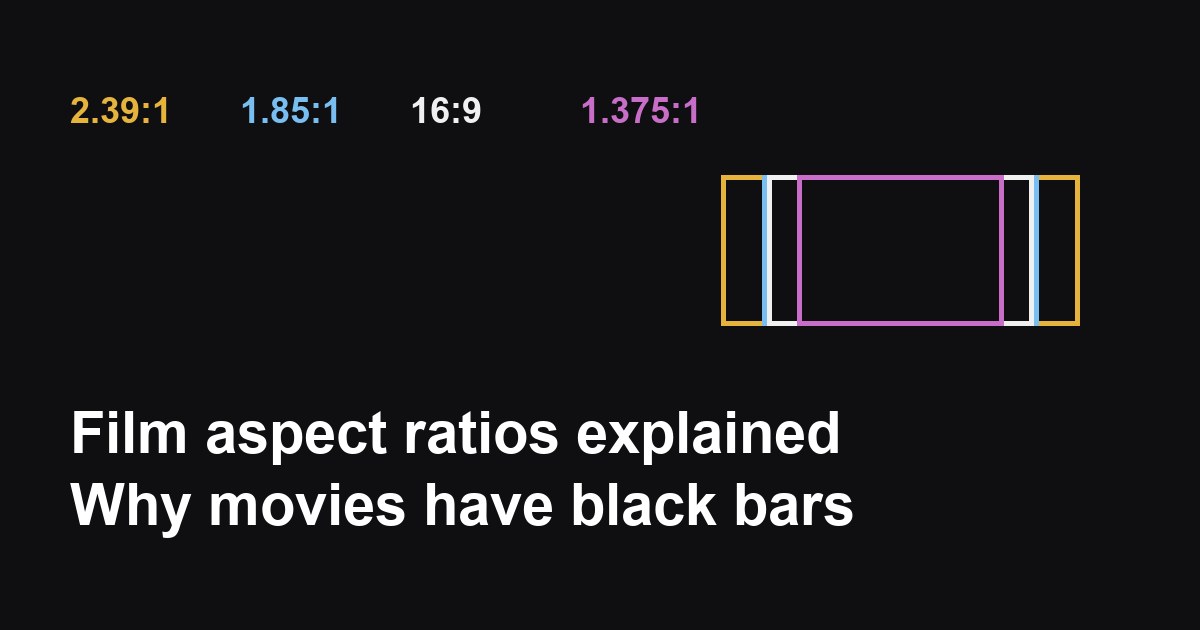
You queue up a favorite movie on a modern TV and notice thick black bands above and below the picture. Switch to an older film and you may see bars on the left and right instead. Neither is a glitch. They are the visible result of aspect ratio, the shape of the picture, and the way film and television standards have changed over the last century. This guide walks through the most common ratios, where they came from, and how to make sense of them at home.
What an aspect ratio is
An aspect ratio is the relationship between an image's width and its height. It is written as two numbers, such as 16:9, or as a single decimal that compares width to a height of one, such as 1.78:1. Both describe the same shape. A larger first number means a wider picture.
Because a film is shot in one shape and a screen has another, something has to give when the two do not match. A display can leave empty bands (letterboxing when the bars are above and below, pillarboxing when they are at the sides), stretch the image, or crop it. The first option shows the picture the way the filmmakers framed it.
The main ratios, in the order they appeared
4:3 and the Academy ratio (about 1.33 to 1.375:1)
Early 35 mm films from the silent era used a 4:3 frame, roughly 1.33:1. According to the Wikipedia article on aspect ratios, the Academy of Motion Picture Arts and Sciences officially adopted a very similar ratio of 1.375:1 in 1932, and it was nearly universal for 35 mm sound films from 1932 to 1953. Published sources round the figure differently: Britannica gives the Academy ratio as 1.33 to 1 (4 to 3), while the Wikipedia article gives 1.375:1 (also written 1.37:1). Treat these as the same family of shapes.
The near match between the Academy ratio and 4:3 mattered later. Early television sets used a 4:3 screen, so, according to the Wikipedia article, movies could be satisfactorily viewed on TV in the early days of the medium, the 1940s and 1950s.
1.85:1: the everyday widescreen
Britannica's history of film says that the growing presence of television pushed studios to find new ways to draw audiences, and that it was the anamorphic CinemaScope process that prompted the wide-screen revolution. The Wikipedia article says the flat 1.85:1 ratio debuted in May 1953 and describes it as a standard 35 mm widescreen format in the United States and United Kingdom. The Wikipedia article adds that in American theaters the common projection ratios are 1.85:1 and 2.39:1. On a 16:9 TV, a 1.85:1 film fits almost perfectly, with only slim bars.
2.35:1 and 2.39:1: the anamorphic "scope" look
Anamorphic widescreen uses special lenses to squeeze a wide picture onto film and expand it again in projection. Britannica credits Henri Chretien with devising the underlying technique in the late 1920s, and says Twentieth Century-Fox debuted its CinemaScope version in 1953 with The Robe. According to the Wikipedia article, SMPTE (the Society of Motion Picture and Television Engineers) standardized anamorphic projection at 2.35:1 in 1957. A 1970 update changed the figure to 2.39:1 to make film splices less noticeable, and a 1993 revision confirmed 2.39:1. The Wikipedia article notes that the ratio is often rounded to, or labeled as, 2.40:1, even though the standard value is about 2.39:1.
On a 16:9 TV, a 2.39:1 film shows noticeable bars above and below the image. This is the most common source of the "black bars" that viewers ask about.
16:9 (1.78:1): the television standard
The 16:9 ratio is described in the Wikipedia article as the international standard for HDTV, for non-HD digital television and for analog widescreen PALplus. It is also the only widescreen ratio that the DVD standard supports natively. When you buy a modern TV, it is almost certainly 16:9, which is why that is the shape other formats get compared against.
IMAX 1.43:1: the tall exception
IMAX uses 70 mm film run horizontally through the camera and projector, which gives each frame a physically larger area. The frame it produces is about 1.43:1, taller relative to its width than a standard widescreen frame, according to the Wikipedia article.
Quick comparison
| Ratio | Common name | Typical use | How it looks on a 16:9 TV |
|---|---|---|---|
| 1.33:1 (4:3) | Silent-era and early TV frame | Silent films, older TV shows | Bars at the sides |
| 1.375:1 | Academy ratio | 35 mm sound films, 1932 to 1953 | Bars at the sides |
| 1.78:1 (16:9) | HD television | HDTV, streaming, many digital programs | Fills the screen |
| 1.85:1 | Theatrical widescreen | Common US theatrical ratio | Very thin bars, top and bottom |
| 2.39:1 (often called 2.40:1) | Anamorphic widescreen | Common US theatrical ratio (anamorphic) | Clear bars, top and bottom |
| 1.43:1 | IMAX 70 mm | IMAX presentations | Bars at the sides |
Why you see bars (and what to do about them)
- Bars at the top and bottom mean the film is wider than your screen. The picture is not missing anything.
- Bars at the sides mean the picture is taller or squarer than your screen, as with older films and older TV shows.
- Zoom or "fill" modes remove the bars by cropping the picture or stretching it. Cropping cuts off part of what the filmmakers framed, and stretching distorts faces and shapes. If you want to see the whole composition, leave your TV on its normal or "original" setting.
- Check the streaming or disc listing. Some services and discs say whether the film is presented in its original ratio. When a title looks cropped, a different release may present it differently.
How to notice ratio as a viewer
Once you know what to look for, aspect ratio becomes part of how a film speaks:
- A wide frame can emphasize landscapes, crowds and distance between characters.
- A taller or squarer frame can feel closer and more focused on a single face or object.
- A film that changes ratio partway through is making a deliberate visual choice.
None of this makes one ratio better than another. It simply gives filmmakers different tools, and gives you something concrete to watch for the next time the black bars appear.
Bottom line
Aspect ratio is the shape of the picture. Films have moved from the nearly square Academy ratio to wider formats such as 1.85:1 and 2.39:1, while televisions standardized on 16:9, so bars are the price of seeing a film as it was framed. Leave your TV on its original-picture setting, and you will see the whole composition.
Sources (all checked 2026-10-09)
- Britannica, "Academy ratio": https://www.britannica.com/topic/Academy-ratio
- Britannica, "History of film: the threat of television": https://www.britannica.com/art/history-of-the-motion-picture/The-threat-of-television
- Britannica, "CinemaScope": https://www.britannica.com/technology/CinemaScope
- Wikipedia, "Aspect ratio (image)" (4:3 in the silent era and early TV, Academy ratio 1932, 1.85:1 introduced by Universal in 1953, SMPTE 2.35:1 in 1957 and 2.39:1 updates in 1970 and 1993, 16:9 as the HDTV and DVD widescreen standard, IMAX 1.43:1): https://en.wikipedia.org/wiki/Aspect_ratio_(image)